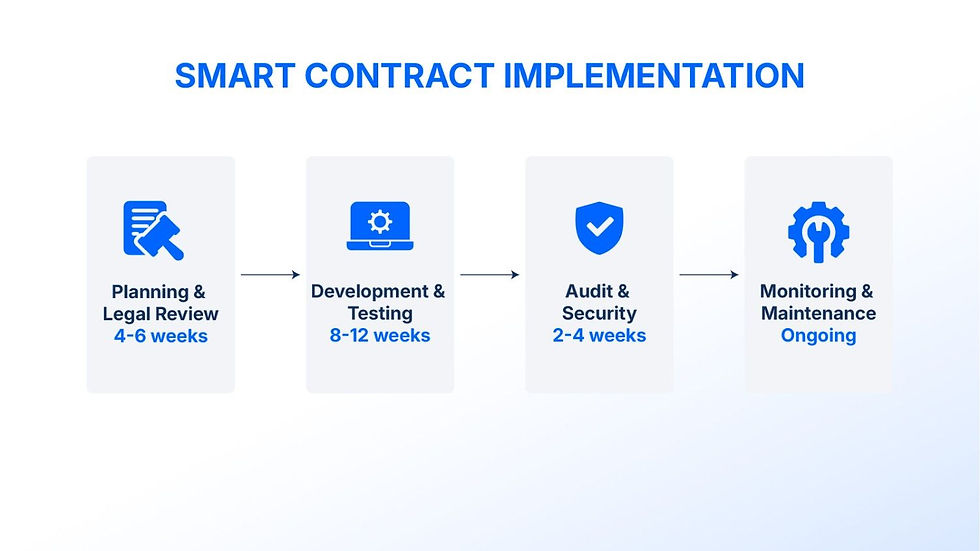
Smart contract monitoring limits to account for
Smart Contract Monitoring works best as a clear sequence: define the constraint, compare the realistic options, test the tradeoff, and choose the path with the fewest hidden costs. That order keeps the advice usable instead of decorative. After each step, pause long enough to check whether the recommendation still fits the reader's actual situation. If it depends on perfect timing, unusual access, or a best-case budget, include a simpler fallback.
The simplest way to use this section is to write down the real constraint first, compare each option against it, and choose the path that still works outside ideal conditions.
Smart contract monitoring choices that change the plan
Choosing a monitoring strategy requires balancing detection speed against implementation cost. No single tool fits every protocol, so you must evaluate how each option handles your specific smart contract architecture. The decision hinges on three concrete factors: latency, data depth, and operational overhead.
Real-Time Alerts vs. Batch Processing
Real-time monitoring captures events as they happen on the blockchain. This approach is essential for high-value protocols where seconds matter. You receive immediate notifications for critical state changes, allowing rapid response to potential exploits.
Batch processing aggregates data over fixed intervals, such as every 100 blocks or hourly. This method reduces infrastructure costs and API usage but introduces latency. For stablecoins or low-risk assets, batch processing may be sufficient, but for flash loan attacks or oracle manipulations, the delay can be catastrophic.
On-Chain Indexing vs. RPC Polling
Indexing services like The Graph or SCSF store parsed event data in efficient databases. This allows complex queries without scanning the entire blockchain history. It significantly lowers the computational burden on your own infrastructure.
Direct RPC polling reads raw data from nodes. It offers the highest level of control and immediacy but requires substantial resources to maintain node health and handle rate limits. For small teams, indexing is often the only scalable path. For large protocols with custom security needs, direct polling might be necessary to catch edge cases.
Cost vs. Coverage
Comprehensive monitoring tools often charge based on the number of contracts tracked or events processed. A basic plan might cover simple token transfers, while advanced features like custom logic analysis or cross-chain monitoring incur higher fees.
Evaluate the total cost of ownership. A cheaper tool that misses critical events is more expensive than a robust platform that prevents a single exploit. Consider the potential loss from a missed alert versus the monthly subscription. For high-stakes applications, the cost of monitoring is negligible compared to the risk of a breach.
| Factor | Real-Time | Batch | Indexing | Polling |
|---|---|---|---|---|
| Latency | Immediate | Delayed (blocks/time) | Low | High |
| Cost | High | Low | Medium | High |
| Complexity | Medium | Low | High | Very High |
| Best For | High-Value DeFi | Stable/Low-Risk | Scalable Apps | Custom Security |
Build a monitoring stack that scales with your contract
Choosing smart contract monitoring tools requires balancing data depth against operational cost. A robust stack does not just alert on errors; it provides the context needed to distinguish between a routine transaction spike and an active exploit. The right infrastructure turns raw blockchain data into actionable intelligence before a position is lost.
- Establish a reliable data source
Start with a trusted indexer or RPC provider that guarantees uptime and data integrity. Services like Alchemy or Infura offer high-throughput access to block data, while specialized platforms like Tenderly provide simulation environments to test contract interactions before they hit mainnet. Reliability here is non-negotiable; missed blocks mean missed alerts. Circle's recent updates highlight how easier access to contract activity reduces the friction of initial setup.
- Define critical event signatures
Not every event matters. Identify the specific function calls and state changes that indicate risk, such as large token transfers, ownership changes, or liquidity removals. Use Solidity event monitoring best practices to optimize these signatures, ensuring your system only processes relevant logs. This reduces noise and prevents alert fatigue during high-traffic periods.
- Configure tiered alerting rules
Implement a hierarchy of alerts based on severity. Low-priority notifications might track gas price spikes or routine maintenance transactions, while high-priority alerts trigger immediate responses for suspicious activity. Use webhooks to integrate these alerts directly into your team’s communication channels, such as Slack or Discord, ensuring rapid visibility.
- Implement automated response workflows
Manual response is too slow for many exploits. Configure automated actions for critical thresholds, such as pausing a contract or freezing transfers. This requires careful testing in a sandbox environment to avoid false positives that could disrupt legitimate user activity. The goal is to create a safety net that activates instantly, giving your team time to assess the situation.
- Review and refine continuously
Monitoring is not a set-and-forget task. Regularly review alert logs to identify false positives and adjust thresholds. As your contract evolves, new attack vectors may emerge, requiring updates to your monitoring rules. Treat your monitoring stack as a living system that adapts to the changing threat landscape.


As an Amazon Associate, we may earn from qualifying purchases.
Spotting Weak Smart Contract Monitoring Options
Most monitoring guides promise full visibility, but many tools miss critical on-chain signals. A common mistake is relying solely on event logs without verifying data redundancy. As SCSFG notes, optimizing data redundancy and understanding event signatures prevents blind spots in your audit trail [1].
Another trap is assuming "easier" means "better." Simplified interfaces often hide the complexity of log analysis. If a tool claims to make monitoring effortless without showing you the underlying query logic, it likely filters out edge cases. Always check if the tool allows custom indexing of non-standard events.
Finally, beware of static price widgets that don't update with contract state changes. For assets like BTC, use provider-backed widgets like TradingView to ensure your risk analysis reflects real-time market conditions, not stale data. A weak monitoring setup leaves you reacting to breaches instead of preventing them.
Smart Contract Monitoring FAQ
How often should I monitor my smart contracts?
Continuous monitoring is the standard for high-stakes contracts. Unlike traditional software, blockchain transactions are immutable, meaning a bug in production cannot be easily patched. Most professional operations run real-time watchers on critical functions like withdrawals, governance changes, and liquidity movements. If you are running a lower-risk utility contract, daily or weekly checks may suffice, but real-time alerts are essential for any contract holding significant value.
Can I monitor smart contracts without writing code?
Yes, several no-code platforms allow you to set up alerts based on on-chain events. Services like Tenderly or Moralis let you define conditions—such as a specific token transfer exceeding a threshold or a new owner being added—and send notifications via email or webhook. These tools abstract the complexity of node synchronization, making them ideal for project managers or founders who need visibility without maintaining a full monitoring infrastructure.
What is the difference between monitoring and auditing?
Auditing is a static, point-in-time review of your code to find vulnerabilities before deployment. Monitoring is a dynamic, ongoing process that watches the contract in action. A clean audit does not guarantee immunity from exploits, such as new oracle manipulations or unexpected economic attacks. Effective security requires both: audits to catch coding errors and monitoring to detect anomalous behavior in real-time.
What are the most common smart contract risks to watch for?
Focus on unauthorized access and economic anomalies. Key signals include unexpected ownership transfers, sudden drains of liquidity pools, or transaction failures that deviate from normal patterns. Monitoring tools should flag events that bypass standard access controls or trigger functions that have not been used recently. Early detection of these anomalies can stop exploits in progress, limiting financial loss.
No comments yet. Be the first to share your thoughts!