Why monitoring matters now
Static audits are no longer enough. They are a snapshot of your code at a single moment in time, but the blockchain is a moving target. Once your smart contract deploys, the attack surface expands. New exploits emerge, gas dynamics shift, and economic conditions change. Without active smart contract monitoring, you are flying blind.
Consider the stakes. A single vulnerability can drain millions in seconds. The difference between a patchable issue and a catastrophic failure is often how quickly you see it. Continuous monitoring acts as your early warning system, detecting anomalies before they become insolvencies.
This section explores the infrastructure and strategy needed to keep your protocol safe after deployment.
The backbone of smart contract monitoring
Smart contract monitoring relies on three distinct technical layers that work together to turn raw blockchain data into actionable intelligence. Without this infrastructure, a monitoring system is blind; it cannot see state changes, detect anomalies, or trigger alerts before funds are lost.
RPC nodes: The entry point
Remote Procedure Call (RPC) nodes are the first line of defense. They provide the interface through which your monitoring scripts query the blockchain. Whether you use a public endpoint or a private infrastructure provider like Infura or Alchemy, the node handles the initial request to fetch block headers, transaction receipts, and current state roots. For high-frequency monitoring, the reliability and latency of your RPC provider directly impact your ability to react to events in real-time.
Event logs: The signal in the noise
While state changes happen in the storage trie, they are emitted as events in transaction logs. These logs are the primary data source for most monitoring tools because they are cheaper to query than full state reads and are indexed by most nodes. Understanding event signatures—unique hashes that identify specific function calls—is essential. As noted in the Smart Contract Security Field Guide, optimizing data redundancy and correctly parsing these event signatures allows you to filter out noise and focus on critical transfers or ownership changes [src-serp-1].
Indexers: Making sense of the data
Raw logs are unstructured and difficult to query efficiently. Indexers solve this by ingesting block data and reorganizing it into relational formats that are easy to query. Tools like The Graph or custom-built indexers transform flat log entries into structured objects, linking transactions to specific contracts and users. This layer is crucial for complex monitoring strategies that require historical context, such as detecting unusual patterns over time or tracking multi-step attack vectors.
Essential monitoring tools
No single platform covers every edge case, so your stack needs to be modular. You are looking for tools that handle specific layers of the smart contract lifecycle, from raw event ingestion to automated remediation. The following tools represent the current standard for institutional-grade monitoring.
OpenZeppelin Defender
Defender is the most widely adopted infrastructure for managing smart contracts at scale. Its Monitor module allows you to create customized templates that watch for specific transactions or events across multiple chains. Instead of polling blocks manually, Defender pushes alerts directly to your team’s communication channels when conditions are met.
The platform shines in its integration with Defender Automate. If a monitor detects a critical anomaly, such as a failed upgrade or unauthorized access, you can trigger pre-approved defensive actions without human intervention. This reduces the window of vulnerability from minutes to seconds.
SCSFG (Smart Contract Security Framework Group)
SCSFG provides a more developer-centric approach, focusing on the structural integrity of the contract code itself. While many tools watch what happens after deployment, SCSFG tools often integrate with the development workflow to catch misconfigurations before they go live. It is particularly useful for teams that want to enforce security policies as code.
The framework emphasizes continuous compliance. Rather than a one-time audit, it runs checks against the contract’s bytecode and source code during the CI/CD pipeline. This ensures that the deployed contract matches the audited version and adheres to established security standards.
Veritas Protocol
Veritas operates as a decentralized oracle network specifically designed for smart contract verification. It provides a trustless layer that monitors on-chain activity and validates the state of contracts against external data sources. This is critical for DeFi protocols that rely on accurate price feeds or event triggers.
By distributing the verification process across multiple nodes, Veritas reduces the risk of a single point of failure. If one node goes offline or is compromised, the network continues to provide accurate monitoring data. This decentralization aligns with the core ethos of Web3 security.
| Tool | Primary Function | Chain Support | Alert Speed |
|---|---|---|---|
| OpenZeppelin Defender | Automated remediation & monitoring | Multi-chain | Near-instant |
| SCSFG | Code compliance & CI/CD integration | EVM-focused | Real-time |
| Veritas Protocol | Decentralized state verification | Multi-chain | Block-level |
Key Takeaways
- Defender is best for automated response and broad chain coverage.
- SCSFG excels in pre-deployment code validation and compliance.
- Veritas provides decentralized verification for trustless environments.
Choosing the right combination depends on your specific risk profile. Most mature protocols use a layered approach, combining Defender for immediate response, SCSFG for code integrity, and Veritas for data accuracy.
Reading the Signals
Monitoring tools are only as good as your ability to interpret what they show. Raw data is just noise until you connect it to context. When you look at a smart contract’s activity, you aren’t just looking at numbers; you are looking for patterns that suggest something is wrong. The goal is to move from reactive firefighting to proactive anomaly detection.
Spotting Anomalies
The most common entry point for exploits is unusual transaction patterns. Look for sudden spikes in gas usage or transactions that deviate significantly from the norm. If a contract that usually processes ten transactions an hour suddenly handles one thousand, that is a signal, not a feature.
Pay close attention to the sequence of calls. Many exploits rely on a specific order of operations. If a user calls a function that shouldn’t be callable in that context, the monitoring tool should flag it immediately. This is where runtime verification comes in handy, allowing you to check contract state against expected behavior in real-time rather than after the damage is done.
Interpreting On-Chain Data
On-chain data tells the story of what happened, but it doesn’t always explain why. You need to correlate transaction hashes with specific contract interactions. A large transfer might look normal on its own, but if it happens right after a price feed update, it could be a flash loan attack in progress.
Use technical charts to visualize these trends. Seeing a spike in volume against a flat price can indicate manipulation. Conversely, a price drop with low volume might just be a lack of liquidity. Context is everything when you are trying to distinguish between a bug, a feature, or a malicious act.
The Role of Real-Time Alerting
Historical analysis is useful for post-mortems, but it is useless for stopping an active exploit. Real-time alerting is your first line of defense. When a potential vulnerability is detected, you need to know within seconds, not hours. This allows you to pause the contract, revoke permissions, or implement a circuit breaker before the attacker can drain funds.
Using Technical Charts for Context
While smart contract monitoring focuses on code and transactions, market data provides the economic context. A contract might be functioning perfectly from a code perspective, but if the underlying asset is being manipulated, the contract is still at risk.
Integrating market data into your monitoring strategy gives you a fuller picture. If you see unusual trading volume in the asset the contract interacts with, it might be worth pausing operations. This doesn’t mean you need to watch every stock ticker, but understanding the market environment helps you make better decisions about contract safety.
Build a smart contract monitoring checklist
Smart contract monitoring isn't just about watching a dashboard; it's about building a safety net that catches anomalies before they become exploits. A structured checklist ensures you don't miss critical signals in the noise of on-chain activity.
Start with infrastructure. You need a dedicated RPC endpoint or a provider like Alchemy or Infura to stream blocks efficiently. Free tiers often throttle requests, leading to missed events during high volatility.
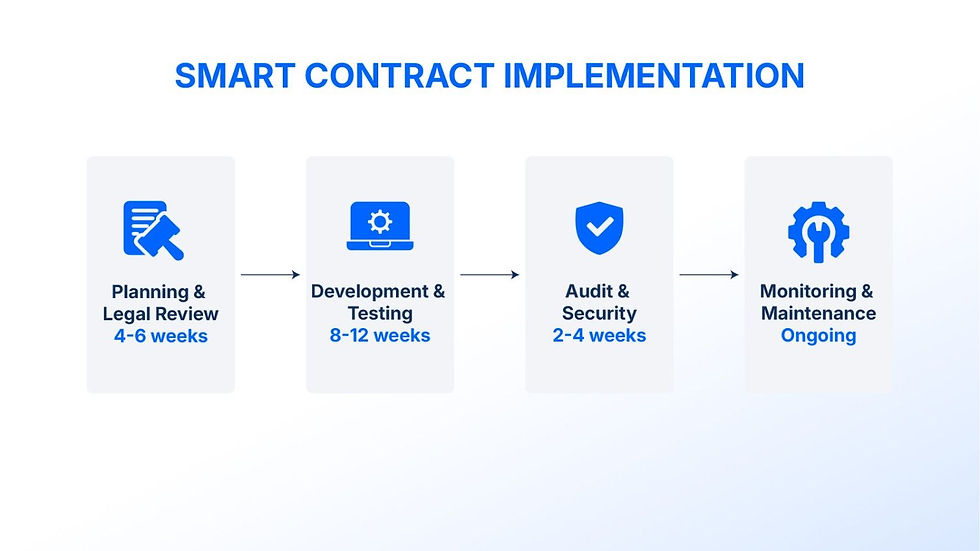
Don't listen to everything. Filter for specific function signatures and event topics relevant to your contract's core logic. This reduces noise and prevents your alert system from drowning in irrelevant transactions.

Set clear triggers for anomalies. Whether it's a sudden spike in gas usage or an unauthorized admin call, define what constitutes a "break" in normal behavior. OpenZeppelin Defender, for instance, allows you to build custom monitor templates for these exact scenarios.

Before going live, run your monitoring setup against testnets or forked mainnet environments. Simulate a reentrancy attack or a price oracle manipulation to verify that your alerts fire correctly and reach the right team members.
A robust monitoring checklist turns passive observation into active defense. By following these steps, you ensure that your smart contract monitoring strategy is both comprehensive and responsive to real-world threats.
Helpful gear
Use these product recommendations as a starting point, then choose the size, material, and price point that fit how you actually use the gear.


As an Amazon Associate, we may earn from qualifying purchases.
No comments yet. Be the first to share your thoughts!