Why real-time monitoring matters now
Smart contract audits are no longer a finish line; they are a starting point. Traditional security reviews provide a static snapshot of code integrity at a specific moment in time. However, once a contract is deployed, it enters a live environment where new vulnerabilities can be discovered, exploits can be developed in real-time, and market conditions can shift to trigger unexpected logic paths. Relying solely on pre-deployment audits leaves a dangerous gap between the code review and the actual execution of funds.
The objective of modern smart contract security is to move from reactive patching to proactive surveillance. This means implementing infrastructure that watches for suspicious activities—such as unusual transaction patterns, sudden liquidity drains, or abnormal gas usage—and triggers alerts or automated responses immediately. Tools like Numen Cyber Technology emphasize that continuous monitoring is essential to detect and respond promptly to any suspicious activities or anomalies that static analysis might miss.
This guide focuses on the concrete tools and infrastructure required to build this active defense layer. We will explore how to set up real-time monitoring systems that integrate with block explorers and on-chain data feeds, ensuring you are not blindsided by the next wave of smart contract risks. The goal is to provide actionable steps for establishing a monitoring posture that keeps pace with the speed of the blockchain.
How EVM Events Power Smart Contract Monitoring
Every interaction with a smart contract—transferring tokens, updating a balance, or executing a trade—leaves a permanent, searchable trace on the blockchain. These traces are called events. Unlike storage variables, which are expensive to read and write, events are designed to be emitted cheaply and indexed efficiently. For any monitoring infrastructure, events are the primary data source.
Think of events as the blockchain’s system logs. They provide a chronological record of state changes without requiring you to query the entire contract state. When a function modifies data, it emits an event with a specific signature and indexed parameters. This structure allows indexing services to filter and sort data rapidly, turning raw blockchain noise into actionable signals.
Every event has a unique hash derived from its name and argument types. This signature acts as the primary key for indexing. Ensure your contracts emit consistent signatures so your monitoring tools can reliably identify relevant transactions across different blocks.
Mark frequently queried arguments as indexed. The EVM stores these values in a special data structure called a log topic, enabling fast filtering. For example, indexing the from and to addresses in a transfer event allows you to quickly find all movements for a specific wallet without scanning every block.
Avoid emitting redundant data that can be derived from the transaction hash or block number. Keep event payloads lean to reduce gas costs and indexing overhead. Only include the minimum necessary data to reconstruct the event’s context for your monitoring queries.
Efficient event design directly impacts the performance and cost of your monitoring stack. By understanding how the EVM processes logs, you can build systems that scale with transaction volume rather than breaking under it. This foundation is critical for real-time threat detection and accurate balance tracking.
Top tools for contract surveillance
Smart contract monitoring isn't about watching a single address; it's about building an early-warning system that catches anomalies before they become insolvencies. The infrastructure landscape has shifted from simple block explorers to specialized platforms that offer customizable alerting, cross-chain aggregation, and automated response capabilities. Choosing the right tool depends on your specific risk profile and technical stack.
OpenZeppelin Defender
OpenZeppelin Defender remains the industry standard for teams prioritizing security and integration depth. Its "Monitor" feature allows developers to define custom conditions—such as large token transfers or specific function calls—and trigger automated actions via Defender Automate. The platform supports a wide range of EVM-compatible chains, making it a versatile choice for multi-chain deployments. Setting up a monitor involves writing simple JavaScript or TypeScript scripts, which are then deployed to Defender's managed infrastructure, ensuring high availability without managing your own servers.
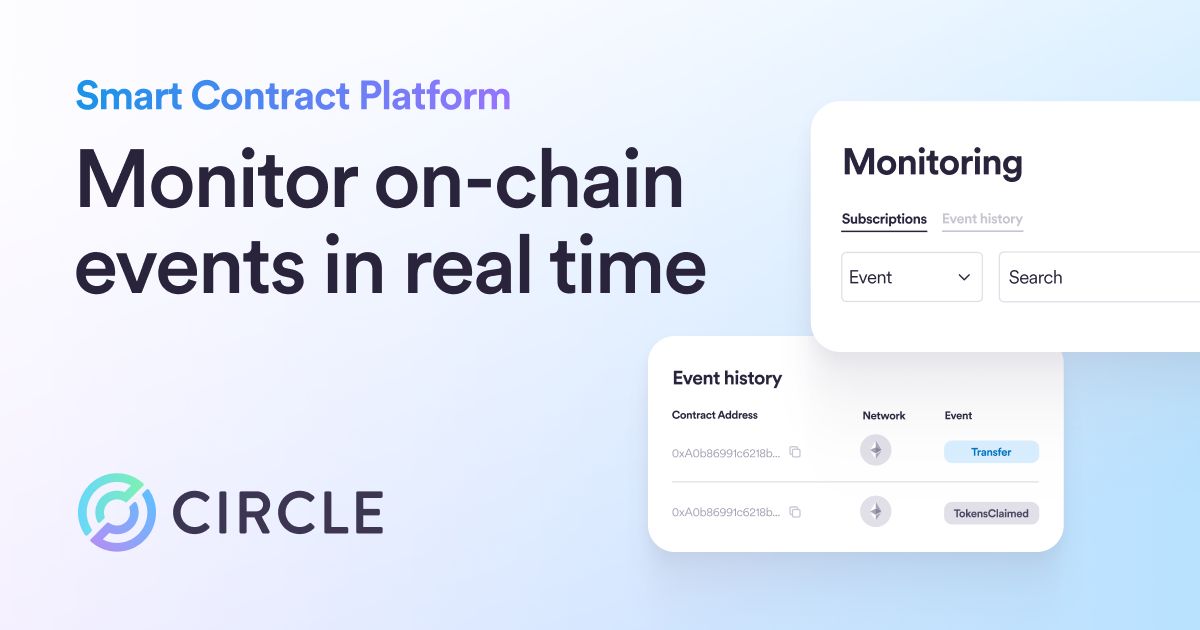
Circle's Smart Contract Monitoring
For projects issuing stablecoins or relying heavily on USDC, Circle offers a streamlined monitoring solution integrated directly into its developer portal. As highlighted in their recent updates, this tool simplifies the process of tracking contract activity with a user-friendly interface that requires minimal coding. It is particularly effective for teams that want quick visibility into transaction flows without building a custom backend. The platform provides real-time alerts and historical data, making it easier to reconcile on-chain activity with off-chain accounting systems.
Custom RPC and Indexer Solutions
For high-frequency trading firms or protocols with unique logic, off-the-shelf tools may lack the granularity needed. In these cases, building a custom indexer using services like The Graph or Alchemy's Notify API offers maximum control. This approach involves writing subgraphs or webhooks that listen for specific on-chain events and push data to your internal monitoring dashboard. While this requires more engineering effort, it allows for precise filtering and lower latency alerts tailored to your exact operational needs.
Comparison of Monitoring Platforms
The table below compares the primary features of these leading solutions to help you decide which fits your infrastructure.
| Platform | Alert Type | Chain Support | Integration Effort |
|---|---|---|---|
| OpenZeppelin Defender | Custom JS/TS Scripts | Multi-EVM | Medium |
| Circle Monitoring | Pre-built Templates | EVM (Stablecoin focus) | Low |
| Custom Indexer | Webhooks/API | Any (via RPC) | High |
Building a risk analysis strategy
Setting up smart contract monitoring isn't just about installing software; it's about defining what "bad" looks like for your specific portfolio. A generic alert for "large transfer" is noise. A specific alert for "approval exceeding $100k from an unverified contract" is intelligence. To build a strategy that actually protects capital, you need to move from passive observation to active risk analysis.
The goal is to create a closed loop: define the threat, set the threshold, and automate the response. Here is how to structure that workflow.
Start by mapping the attack surface. Most exploits stem from a handful of predictable actions: unexpected token approvals, ownership transfers, or liquidity pool drains. Identify which functions in your monitored contracts are "critical." For example, if you hold a governance token, an "admin change" event is high-risk. If you are holding a stablecoin, a "pause" event might be the primary concern. Document these specific event signatures in your monitoring tool's filter settings. This narrows the signal-to-noise ratio significantly.

Static thresholds fail because market conditions change. A $50,000 transfer might be routine for a DeFi protocol but suspicious for a small DAO treasury. Use dynamic thresholds based on historical averages or volatility metrics. Many monitoring platforms allow you to set alerts relative to the asset's 24-hour volume or price impact. This ensures your alerts remain relevant during both calm markets and high-volatility events, reducing alert fatigue while catching anomalies that deviate from normal behavior.
Detection is useless without a defined response. Automate the initial reaction to reduce human error during a crisis. For high-severity alerts, this might mean automatically pausing a trading bot, freezing a wallet via a multisig timelock, or sending a direct message to the security team via Telegram or Slack. For lower-severity anomalies, a simple email digest may suffice. Document these playbooks and test them. When an exploit is in progress, every second counts; you cannot be reading documentation while the attacker is draining funds.
This approach transforms monitoring from a reactive checklist into a proactive defense layer. By focusing on critical events, dynamic context, and automated responses, you build a system that scales with your portfolio size and complexity.
Common questions about monitoring
Can AI tools audit smart contracts? AI models like GPT-4 show promise in parsing contract code and identifying functional relationships, but they are not yet standalone security guarantees. Research indicates that while these models can identify background context, they only successfully generate usable proof-of-concept exploits in about 60% of cases. Use AI for initial code review, but always pair it with formal verification tools to catch logic errors.
How do I check if a smart contract is safe? Start by pasting the contract address into a block explorer like Etherscan. Verify that the source code is published and verified; anonymous contracts carry higher risk. Check for a recognizable project name and active developer interaction. If the code is unverified or the contract is brand new with no transaction history, exercise extreme caution.
What is the best way to monitor contracts continuously? Continuous monitoring is essential for detecting anomalies in real-time. Tools like Numen Cyber provide mechanisms to track suspicious activities and flag deviations from expected behavior. Set up alerts for large token movements or unusual function calls to respond promptly to potential exploits before they cause significant damage.
Helpful gear
Use these product recommendations as a starting point, then choose the size, material, and price point that fit how you actually use the gear.


As an Amazon Associate, we may earn from qualifying purchases.
No comments yet. Be the first to share your thoughts!